
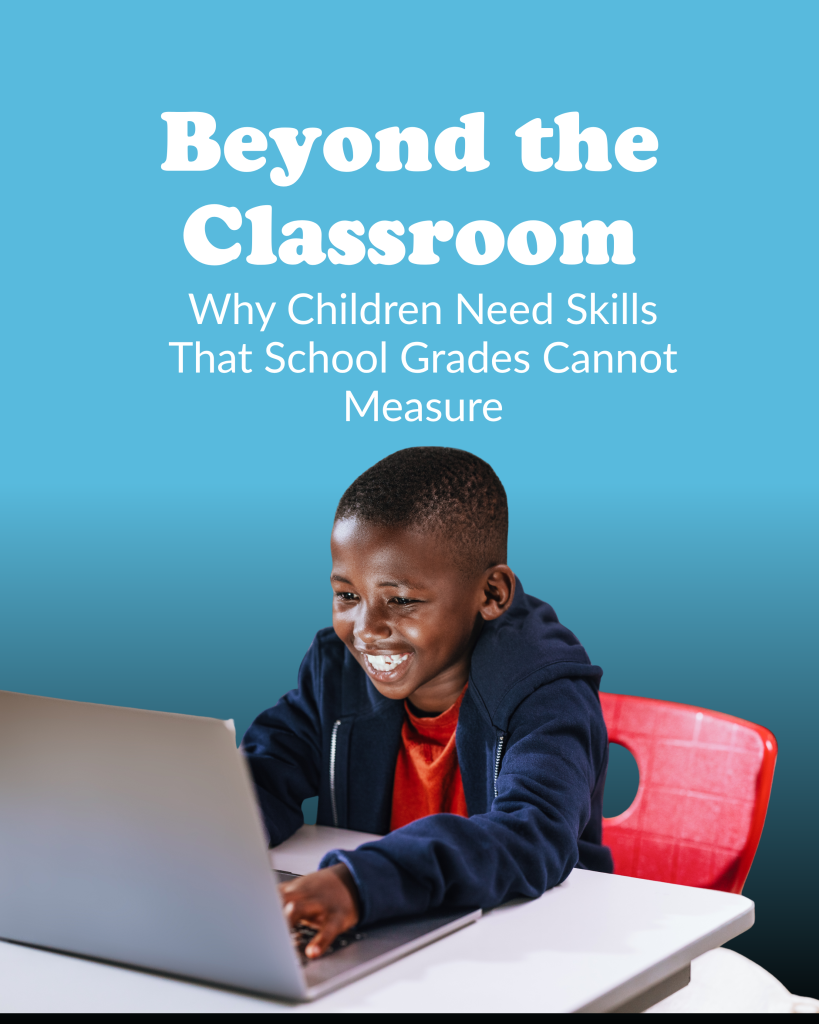
Why Children Need Skills That School Grades Cannot Measure
Academic grades are often one of the first things parents look at when evaluating a child’s performance. Good grades can reflect hard work, understanding, and preparation. However, they do not always reveal the full range of skills a child needs to succeed.
Can a child communicate their ideas clearly? Can they work with others, think through unfamiliar problems, or adapt when something does not go according to plan?
These abilities are important too.
Education should prepare children not only to pass examinations but also to understand the world around them, relate with others, solve problems, and make meaningful contributions to their communities.
This is why learning beyond traditional academic subjects matters.
1. Communication and Self Expression
Children need to learn how to express their thoughts, explain their opinions, ask questions, and listen to others.
Communication goes beyond speaking fluently. It involves understanding an audience, organising ideas, choosing appropriate words, and responding thoughtfully.
These skills are useful in classrooms, friendships, group projects, future workplaces, and everyday interactions.
Parents can encourage communication by involving children in conversations, asking them to explain their opinions, and creating opportunities for them to speak in front of others.
2. Critical Thinking and Problem Solving
Children encounter problems every day, both in and outside the classroom. They need to develop the ability to examine situations, consider different possibilities, and make informed decisions.
Critical thinking encourages children to look beyond the first answer they encounter.
Instead of simply telling a child what to do, parents and educators can ask questions such as:
- Why do you think that happened?
- What other approach could you try?
- What evidence supports your answer?
- What would you do differently next time?
These questions encourage children to reason independently rather than rely entirely on instructions.
3. Creativity and Innovation
Creativity is not limited to drawing, painting, music, or other artistic activities. It also involves imagining possibilities, exploring ideas, and finding new ways to approach challenges.
A creative child may develop an interesting solution to a mathematics problem, invent a game, write a story, or find a different way to complete a project.
Giving children opportunities to experiment, create, and explore helps them become more confident in their ideas.
It is also important to allow room for mistakes. Children need to understand that not every attempt will produce the desired result, and that trying again is part of learning.
4. Collaboration and Teamwork
Learning to work with others is an important part of a child’s development.
Through group activities, children learn to share responsibilities, respect different opinions, listen, negotiate, and contribute towards a common goal.
Parents can encourage teamwork through family activities, group projects, sports, and other shared responsibilities.
These experiences help children understand that working effectively with others sometimes requires patience, compromise, and consideration.
5. Adaptability and Independence
The ability to adjust to new situations is another valuable skill.
Children may encounter unfamiliar subjects, new learning environments, challenging assignments, or unexpected changes. Rather than becoming discouraged immediately, they need to develop the confidence to approach these situations with curiosity and a willingness to learn.
Encouraging children to take responsibility for age appropriate tasks, manage their time, and make simple decisions can help build independence.
How Parents Can Encourage These Skills
Developing these abilities does not require parents to organise elaborate programmes or activities every day.
Simple everyday experiences can make a difference.
Encourage children to participate in conversations, read widely, explore their interests, take part in group activities, and attempt age appropriate challenges independently.
Allow them to ask questions and express their opinions respectfully. Give them opportunities to make decisions and learn from the consequences of their choices.
Most importantly, recognise that these skills develop gradually through practice and encouragement.
Final Thoughts
Academic achievement remains important, but a child’s education should not be measured by grades alone.
Children need opportunities to communicate, think critically, collaborate, create, and become independent learners. These abilities complement classroom learning and prepare them to navigate situations that cannot always be addressed through textbooks.
At Soundmind, we recognise the importance of supporting the whole learner. Education should build knowledge while also helping children develop the confidence and practical skills they need beyond the classroom.


