
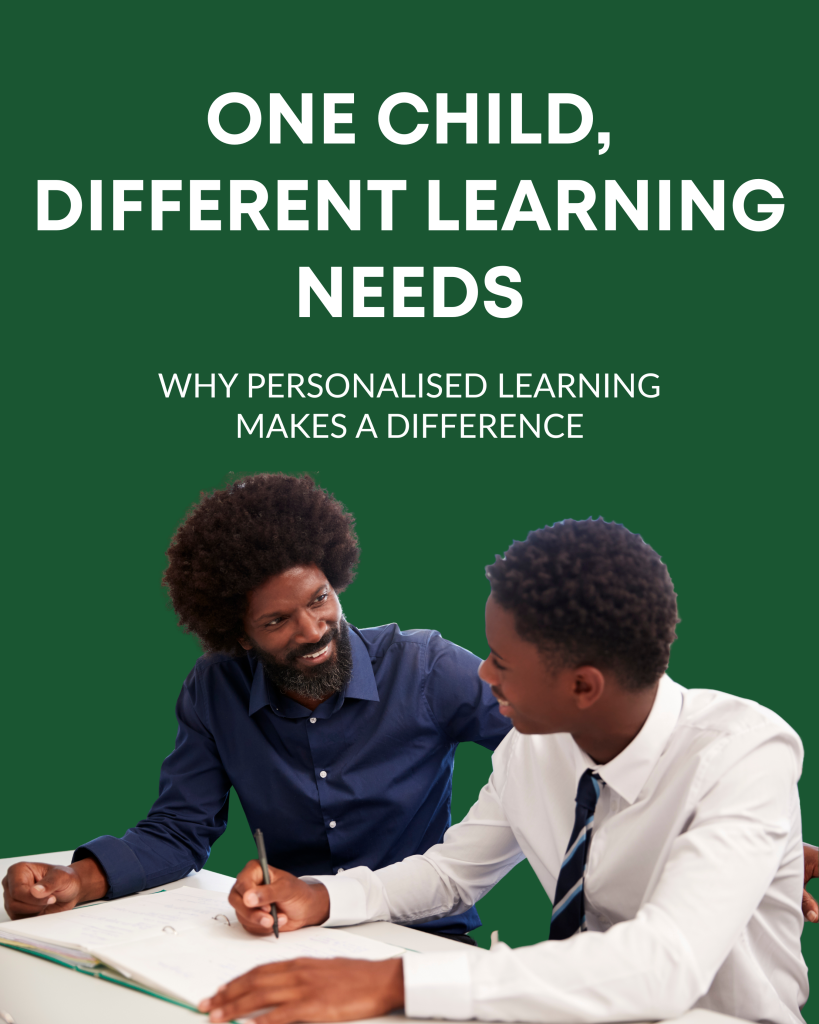
Why Personalised Learning Makes a Difference
Have you ever wondered why two children in the same class, taught by the same teacher, can have completely different learning experiences?
One child may understand a new mathematical concept after a single explanation, while another needs to see examples and practise several times. One may enjoy reading independently, while another learns better through discussions and guided activities.
These differences are a normal part of learning.
Children have different strengths, interests, experiences, and areas of difficulty. This means that the same teaching approach may not produce the same results for every learner.
Understanding these differences is an important step towards helping children make meaningful academic progress.
Every Child Has a Different Starting Point
Children do not all begin a school year with the same level of understanding.
Some may have strong foundational knowledge from previous classes, while others may have missed important concepts or need additional time to understand certain topics.
For example, a child struggling with multiplication may actually need to revisit addition and number patterns. A student who finds essay writing difficult may need support with sentence construction, vocabulary, and organising ideas.
If these underlying difficulties are not identified, the child may continue to struggle as lessons become more advanced.
Personalised learning begins by understanding what a child already knows and identifying what they need to learn next.
What Is Personalised Learning?
Personalised learning involves adapting teaching and learning experiences to address individual student needs.
It considers factors such as:
- The child’s current level of understanding.
- Their academic strengths and areas for improvement.
- Their pace of learning.
- Their interests and learning goals.
- The type of guidance and practice they require.
This does not mean that every lesson must be completely different. It means that teaching decisions should take the individual learner into consideration.
A student who has already mastered a topic may need more challenging activities, while another may benefit from additional explanations and guided practice.
5 Benefits of Personalised Learning
1. It Helps Identify Learning Gaps
When teaching is responsive to a child’s needs, it becomes easier to recognise areas where they require additional support.
Rather than repeatedly moving forward without understanding, students can revisit important concepts and strengthen their foundations.
2. It Allows Children to Learn at a Suitable Pace
Some topics require more practice than others.
Personalised learning gives children the opportunity to spend more time on difficult concepts without feeling unnecessarily pressured to keep up with everyone else.
It also allows students who understand a topic quickly to explore more challenging material.
3. It Builds Confidence
Repeatedly struggling with schoolwork can affect a child’s confidence.
When lessons are adjusted to their level of understanding, children have more opportunities to experience progress and recognise their own abilities.
Small improvements can encourage them to participate more actively and approach difficult tasks with a more positive attitude.
4. It Encourages Active Participation
Children are more likely to engage when learning activities are relevant, appropriately challenging, and connected to their interests.
A student who struggles with a particular topic may become more interested when it is explained using familiar examples, practical activities, or guided exercises.
Engagement makes learning more meaningful and gives educators opportunities to understand how students are responding.
5. It Supports Long Term Academic Development
The purpose of personalised learning is not simply to help children perform better in one test.
It is to build a stronger understanding of concepts, develop useful academic skills, and prepare students for more advanced learning.
When foundational gaps are addressed and strengths are developed, children are better equipped to approach future academic challenges.
How Can Parents Support Their Child’s Individual Learning Needs?
Parents do not need to be experts in every subject to support their children’s education.
Start by paying attention to how your child responds to different learning experiences.
Ask about subjects they enjoy, topics they find difficult, and the areas where they would like more help.
Communicate with teachers and tutors about your child’s progress. Share observations about their study habits and any difficulties you notice at home.
Avoid comparing your child’s academic journey with that of siblings or classmates. Instead, focus on their individual progress and the steps they can take to improve.
Where necessary, consider additional academic support that can provide more focused attention.
How Soundmind Supports Individual Learning Needs
At Soundmind, we recognise that meaningful academic progress begins with understanding the learner.
Our tutoring approach considers each student’s academic needs, strengths, and areas requiring improvement. Through personalised support, guided practice, and progress monitoring, we aim to help students develop a stronger understanding of their subjects.
Whether a child needs help strengthening foundational skills, preparing for assessments, or building confidence in a particular subject, the learning experience should be responsive to their needs.
Final Thoughts
There is no single approach that works perfectly for every child.
Some students need additional practice, others need a different explanation, and some require more challenging opportunities to develop their abilities.
What matters is recognising these differences and providing the right support.
When children receive learning experiences that consider their individual needs, they have a better opportunity to understand, grow, and reach their potential.
Every child deserves the opportunity to learn in a way that helps them succeed.


